Chongqing
China's mountain metropolis
Chongqing (重庆, Chóngqìng) is one of China's four direct-administered municipalities, situated in the southwest on the steep slopes above the confluence of the Yangtze and Jialing rivers. The municipality covers an unusually large area comparable to Austria and includes the urban core, satellite districts, and vast mountainous and rural counties extending far up the Yangtze, with a total population of over 30 million. Chongqing is the largest city in southwest China and a major industrial, transport, and river-port center, known for its hot summers and famously spicy hotpot.
Chongqing's history reaches back over 3,000 years, and it served as the capital of the Ba kingdom before being absorbed into the Qin empire. The city took on outsized national significance during the Second Sino-Japanese War, when the Nationalist government retreated here in 1937 and made Chongqing China's wartime capital, drawing factories, universities, and refugees from the occupied coast. After the war the capital returned to Nanjing, but in 1997 the central government separated Chongqing from Sichuan and elevated it to a direct-administered municipality to drive development of the upper Yangtze and the southwest.
Today Chongqing offers visitors a vertiginous, three-dimensional city of skyscrapers cascading down hillsides, cable cars over the rivers, and a skyline few Chinese cities can match. The old center around Ciqikou preserves a riverside market town of Qing-era lane houses, while the wartime buildings and the Stilwell Museum record the 1937-45 capital period. The Three Gorges Museum and the great bridges across the Yangtze and Jialing, the hotpot restaurants of the old lanes, and the surrounding karst and river scenery toward Wulong and the Three Gorges make Chongqing a gateway to the upper Yangtze as much as a city in itself.
Highlights
Hongya Cave
Hongya Cave (洪崖洞, Hóngyá Dòng) is an eleven-story stilted building complex built into a cliff face above the Jialing River, designed to recall traditional Chongqing river-town architecture.
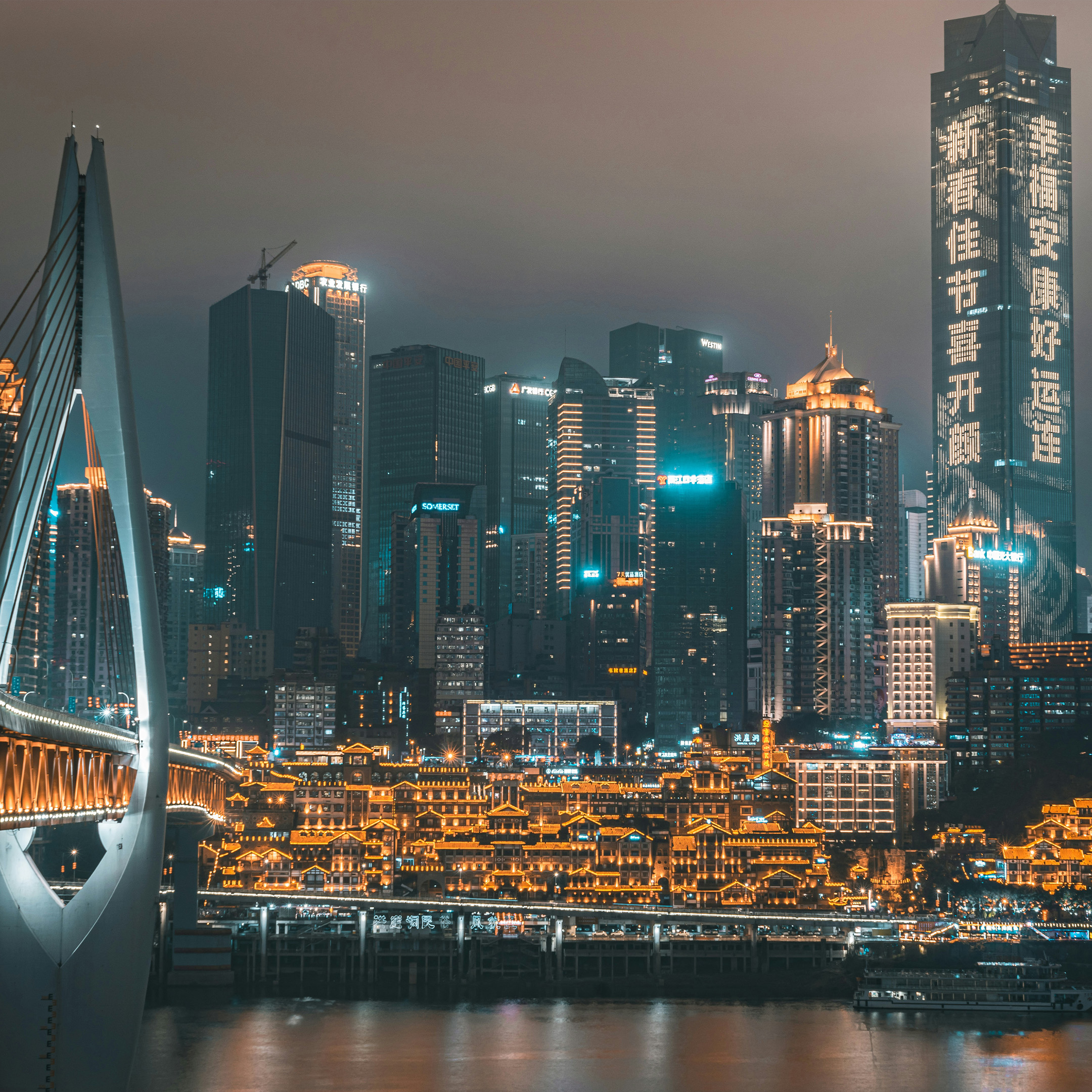
By night its tiers of lanterns and restaurants light up to create one of the city's most photographed scenes, with the modern bridges of the riverside glowing behind it.

Ciqikou Ancient Town
Ciqikou Ancient Town (磁器口, Cíqìkǒu) is a thousand-year-old porcelain trading port on the Jialing River, now a pedestrian maze of stone lanes, teahouses, and Sichuan snack stalls.
Despite the crowds, the old guild halls, courtyard houses, and riverside steps offer a glimpse of pre-skyscraper Chongqing at the edge of the modern metropolis.

Attractions

Jiefangbei Pedestrian Street
Chongqing's central commercial district around the Liberation Monument

Eighteen Steps (Shibaladong)
Historic hillside neighborhood on the Yuzhong Peninsula

Hongya Cave
Eleven-story stilted structure built into a cliff above the Jialing River


People's Square and Great Hall of the People
1950s auditorium modeled after Beijing's Temple of Heaven

Chongqing Three Gorges Museum
Major museum covering the Three Gorges and Chongqing's history

Chongqing Planning Exhibition Gallery
Urban planning museum showcasing the city's growth


Chongqing Grand Theatre
Riverside performance hall at the confluence of two rivers

Jiangbei Grand Mosque
Historic mosque blending Chinese and Islamic architecture


Ciqikou Ancient Town
Thousand-year-old porcelain trading port on the Jialing River


Nanshan Mountain
Forested mountain with viewpoints, temples, and botanical gardens

Yangtze River Cableway
Last surviving cross-river cable car in China

Stilwell Museum
WWII heritage site dedicated to General Stilwell and wartime Chongqing

Liziba Monorail Station
Famous station where the monorail passes through a residential building

Dazu Rock Carvings
UNESCO World Heritage cliff sculptures dating to the 9th–13th centuries

Wulong Karst National Geology Park
UNESCO World Heritage karst landscape with natural stone bridges and caves
Chongqing Skyline
Chongqing

