Macau
Gaming and Portuguese heritage
Macau (澳门, Àomén) is a Special Administrative Region of China on the Pearl River Delta, consisting of the Macau Peninsula, the islands of Taipa and Coloane, and the reclaimed Cotai Strip between them. The region has a population of around 680,000 in an area of just 33 square kilometers, making it one of the most densely populated places on earth, and sits about 60 kilometers west of Hong Kong. Macau operates under the "one country, two systems" framework, and is the only part of China where casino gambling is legal.
Macau was a sparsely inhabited fishing coast until Portuguese traders established a permanent settlement in 1557, paying rent to the Ming dynasty and gradually turning the peninsula into a Portuguese trading entrepôt and Catholic mission base. The colony's importance declined as Hong Kong rose under the British in the 19th century, and after 1949 Macau became a quiet, somewhat faded Portuguese outpost until the late 20th century. In 1999 Portugal handed Macau back to China under the 50-year "one country, two systems" framework, and the subsequent opening of the casino industry to foreign operators turned it into the world's largest gambling market.
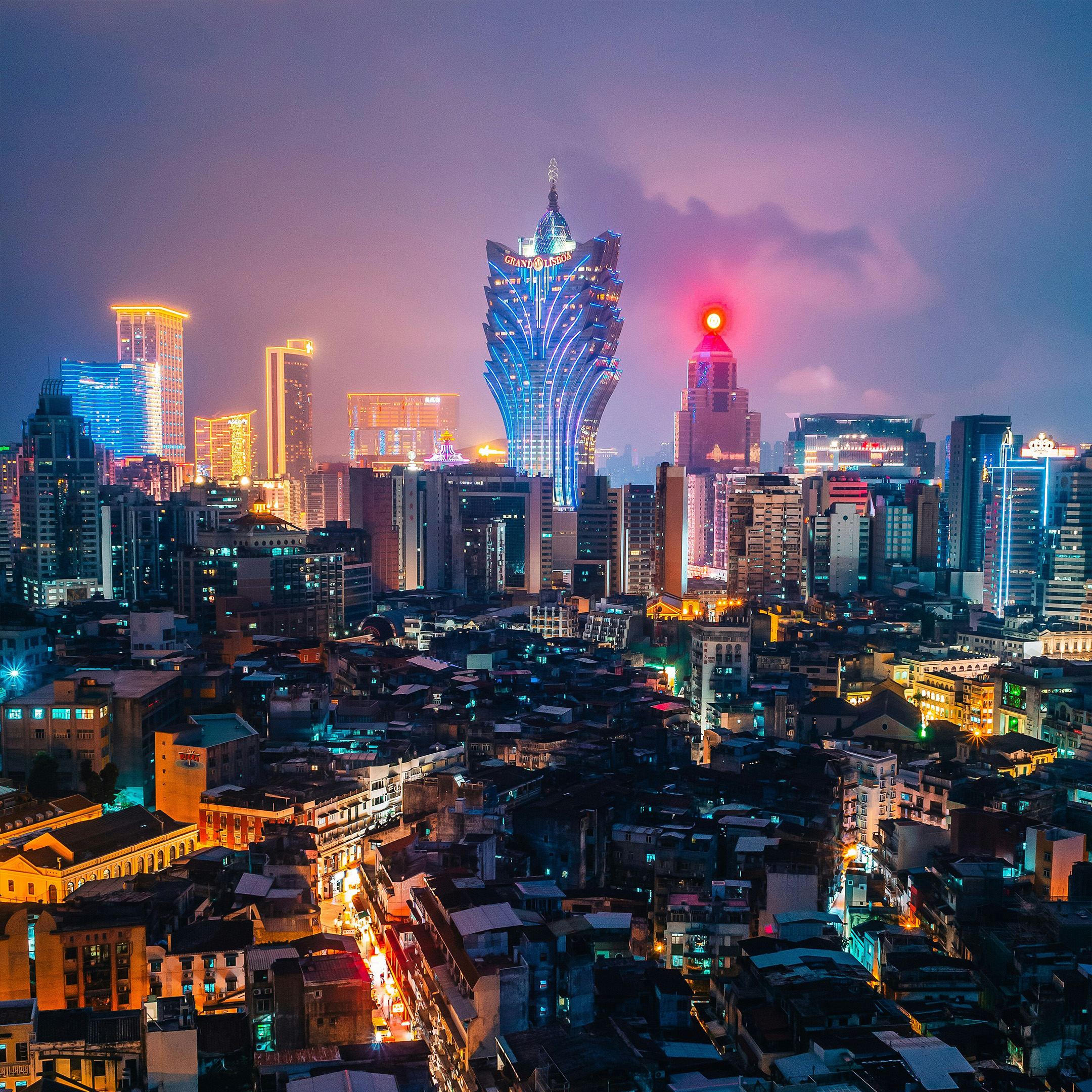
Today Macau offers visitors an unusual mix of Portuguese colonial architecture, Catholic churches, Taoist temples, and enormous casino resorts. The single stone facade of St. Paul's Cathedral, the baroque churches and cobblestone squares of the old peninsula, and the A-Ma Temple record the city's Luso-Chinese past, while the ruins of the Protestant cemetery and the Guia Fort and lighthouse give a sense of its colonial history. The Cotai Strip's enormous casino-resorts, the older casinos of the peninsula, and the quieter villages of Taipa and Coloane round out a city that is half heritage site, half gambling resort.
Highlights
Ruins of St. Paul's
The Ruins of St. Paul's (大三巴牌坊, Dàsānbā Páifāng) are all that remains of a 17th-century Jesuit church, its carved stone facade rising above the old city as the symbol of Macau.
The baroque reliefs blend European, Chinese, and Japanese motifs, reflecting Macau's role as the meeting point of East and West during the Age of Exploration.

Senado Square
Senado Square (议事亭前地, Yìshìtíng Qiándì) is the heart of the UNESCO-listed historic center, a wave-patterned pedestrian square surrounded by neoclassical Portuguese buildings, churches, and narrow shopping lanes.
It is the starting point for a walking tour of Macau's colonial core, leading through tiled streets to St. Dominic's Church, the Ruins of St. Paul's, and the old Chinese quarters beyond.

Attractions


Ruins of St. Paul's
The preserved stone facade of a 17th-century Jesuit church, a central landmark of Macau

Senado Square
The central public square of the UNESCO-listed historic district, surrounded by neoclassical Portuguese buildings

Fortaleza do Monte
A 17th-century hilltop fortress at the center of the Macau Peninsula

Guia Fortress and Lighthouse
The highest point on the Macau Peninsula, with the oldest lighthouse on the Chinese coast

Lou Kau Mansion
A restored late-19th-century merchant's residence blending Chinese and European decorative styles

Mandarin's House
A large Qing-era courtyard residence associated with writer and reformer Zheng Guanying

St. Lazarus District
A residential neighborhood of colonial-era houses that has become a center for arts and creative activity

Macau Tower
A 338-meter observation and entertainment tower on the Macau Peninsula waterfront

Macau Grand Prix Circuit
A 6.2-kilometer street circuit hosting international motorsport since 1954

Taipa Village
A former fishing settlement on Taipa Island, now a food and heritage destination

Taipa Houses Museum
Five Portuguese colonial houses on the Taipa waterfront, preserved as a museum of Macanese domestic life

Cotai Strip
A belt of large integrated resort casinos on reclaimed land between Taipa and Coloane

Coloane Village
A quiet former fishing settlement on Macau's southernmost island

Hac Sa Beach and Coloane Trails
A dark sand beach and forested hill trails at Macau's southern edge
Macau Skyline
Macau

