Xi'an
Ancient capital of China
Xi'an (西安, Xī'ān) is the capital of Shaanxi Province in northwest China, situated on the Wei River floodplain at the southern end of the Guanzhong plain about 1,000 kilometers southwest of Beijing. The municipality covers a large area that includes the old walled city, suburban districts, and surrounding loess and mountainous counties, with a population of over 12 million. Xi'an is the political, economic, and cultural center of northwest China, a major educational center, and the most visited historical destination in the country.
Xi'an, known historically as Chang'an, served as the capital of thirteen Chinese dynasties, most notably the Qin, Han, Sui, and Tang, during which it was one of the largest and most cosmopolitan cities in the world, the eastern terminus of the Silk Road, and a center of Buddhism in China. The Terracotta Army, thousands of life-sized clay soldiers buried with the First Emperor Qin Shi Huang around 210 BCE and discovered in 1974, is the most famous archaeological site in China. After the Tang, the city declined as the political center moved east, and the present Ming-era city wall and drum towers date from a later, more modest period of its history.
Today Xi'an offers visitors a deep, layered antiquity of buried armies, Tang pagodas, and Silk Road heritage within a complete Ming-era city wall. The Terracotta Army in the eastern outskirts is the city's main attraction, while the Ming-era city wall, the Big Wild Goose Pagoda and Small Wild Goose Pagoda, and the Shaanxi History Museum record the city's long imperial past. The Muslim Quarter and the Great Mosque, which reflect the city's continuing Hui Muslim community descended from Silk Road traders, the old lanes around the Bell and Drum Towers, and the surrounding Han and Tang tombs round out one of China's essential historical cities.
Highlights
Terracotta Warriors
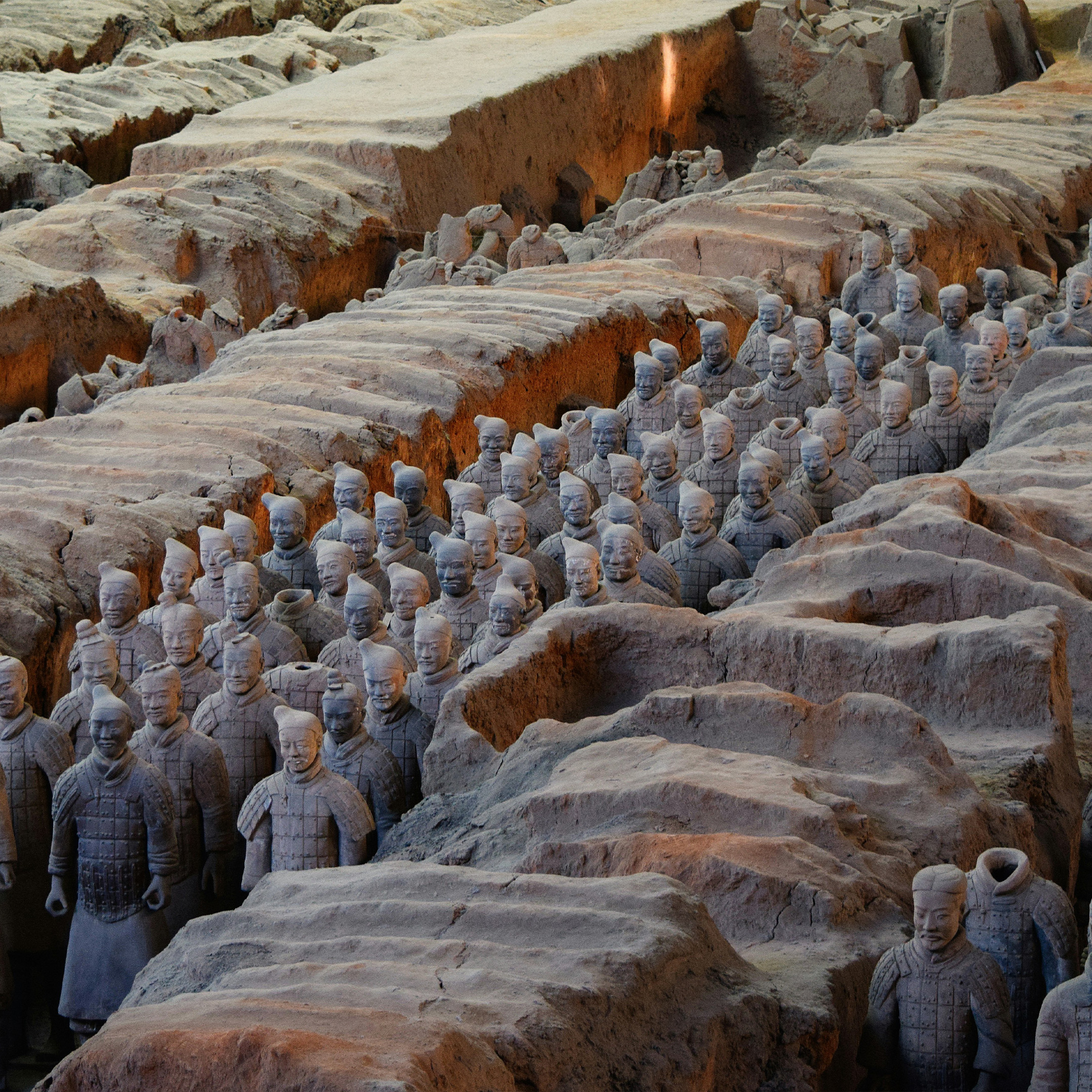
The Terracotta Warriors (兵马俑, Bīngmǎ Yǒng) are thousands of life-sized clay soldiers, horses, and chariots buried in battle formation to guard the tomb of Emperor Qin Shi Huang.
Discovered by farmers in 1974, the army is spread across several vast pits east of the city and remains one of the most important archaeological finds anywhere in the world.

City Wall of Xi'an
The City Wall of Xi'an (西安城墙, Xī'ān Chéngqiáng) is one of the most complete ancient city fortifications in the world, encircling the old city in a 14-kilometer rectangle of Ming Dynasty brick and ramparts.
Cycling along the top gives a rare elevated view of the Bell Tower, the old city rooftops, and the modern towers rising beyond the Ming gates.

Attractions

Bell Tower and Drum Tower
Twin Ming Dynasty landmarks standing at the crossroads of Xi'an's old walled city

Beilin Museum (Forest of Steles)
Collection of over 3,000 inscribed stone tablets housed in a former Confucian temple

Muslim Quarter
Vibrant neighborhood of narrow lanes behind the Drum Tower, home to Xi'an's Hui Muslim community for over a thousand years

Great Mosque of Xi'an
One of the oldest and most distinctive mosques in China, blending Chinese courtyard architecture with Islamic worship

City Wall of Xi'an
One of the most complete ancient city fortifications in the world, encircling Xi'an's old city in a 14-kilometer rectangle

Yongxingfang Food Court
Traditional-style food court built against Xi'an's eastern city wall, showcasing Shaanxi regional cuisine and folk arts

Big Wild Goose Pagoda (Dayanta)
7th-century Buddhist pagoda built to house scriptures brought from India by the monk Xuanzang

Small Wild Goose Pagoda
8th-century Buddhist tower that has survived dozens of earthquakes, set in the tranquil grounds of Jianfu Temple

Shaanxi History Museum
One of China's four great national museums, housing over 370,000 artifacts spanning 13 dynasties

Tang Paradise
Imperial-themed garden park recreating the landscape and court life of the Tang Dynasty

Daming Palace National Heritage Park
UNESCO-listed ruins of the Tang Dynasty's largest imperial palace, once four times the size of the Forbidden City

Hanyangling Mausoleum
Han Dynasty imperial burial complex with an innovative underground museum featuring glass floors above excavated pits

Da Tang West Market Museum
Museum built directly over the excavated ruins of the Tang Dynasty Western Market, a major hub of Silk Road commerce

Terracotta Warriors
World-famous archaeological site containing thousands of life-sized clay soldiers built to guard the tomb of Emperor Qin Shi Huang

Huaqing Palace
Tang Dynasty hot spring resort at the foot of Mount Li, known for imperial bathing pools and a pivotal moment in modern Chinese history

Mount Hua (Huashan)
One of China's five sacred Taoist mountains, known for its precipitous trails and dramatic granite peaks
Terracotta Warriors
Xi'an

