Hangzhou
China's scenic lake paradise
Hangzhou (杭州, Hángzhōu) is the capital of Zhejiang Province on China's east coast, situated at the southern end of the Grand Canal about 180 kilometers southwest of Shanghai. The municipality extends from the urban core around West Lake to the Qiantang River and suburban mountainous counties, with a population of over 12 million. Hangzhou is one of the wealthiest cities in China, a major tech hub as the home of Alibaba, and the political and cultural center of northern Zhejiang.
Hangzhou was founded as a county in the Qin dynasty and rose to national significance when it became the capital of the Wuyue kingdom in the 10th century and then the capital of the Southern Song from 1138 to 1279, during which it grew into one of the largest and most prosperous cities in the world. The Song court's patronage of West Lake, the temples, and the surrounding gardens produced the landscape that has been celebrated in Chinese poetry and painting for a thousand years. After the Song fell to the Mongols, Hangzhou lost its political role but remained a wealthy commercial center, and in the reform era it re-emerged as a leading tech and private-sector economy.
Today Hangzhou offers visitors a celebrated landscape of lake, gardens, and temples at the city's center, alongside a fast-growing modern city. West Lake, with its causeways, bridges, and surrounding hills of temples and pagodas, is the main attraction and a UNESCO World Heritage Site, while the Lingyin Temple and the tea villages of Longjing in the hills to the west give a quieter, older side of the city. The Grand Canal and the old Qinghefang street preserve something of Hangzhou's merchant past, and the city's restaurants, silk shops, and museums round out one of China's most pleasant urban destinations.
Highlights
West Lake
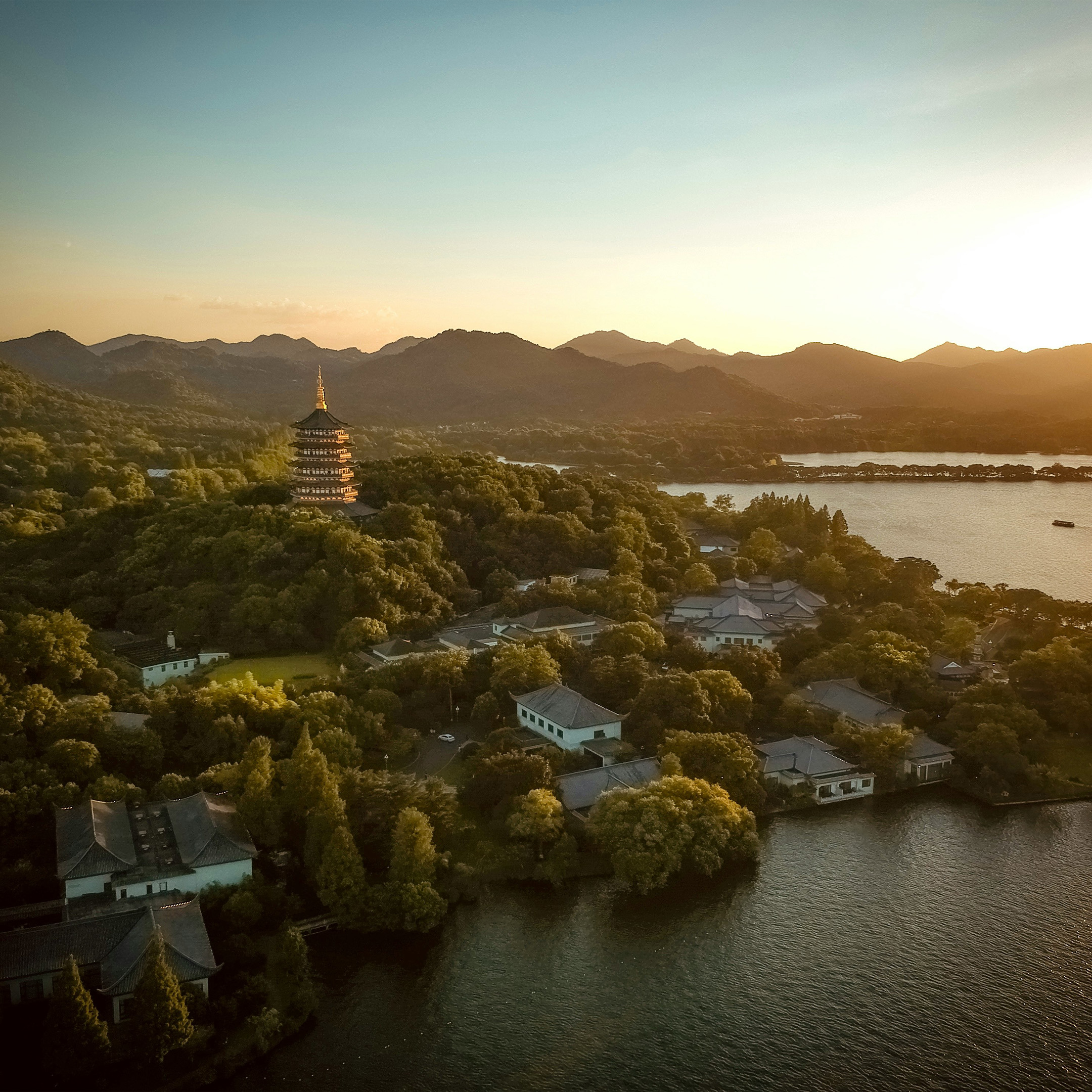
West Lake (西湖, Xīhú) is Hangzhou's heart, a UNESCO-listed freshwater lake fringed by willows, causeways, pavilions, and pagodas that has inspired Chinese poets and painters for a millennium.
The best way to experience it is on foot or by bike along Bai and Su causeways, or by boat to the island pagodas, with views changing through every season from lotus summer to misty winter.

Lingyin Temple
Lingyin Temple (灵隐寺, Língyǐn Sì) is one of China's largest and wealthiest Buddhist monasteries, set in a forested valley beneath the Peak Flown From Afar and famous for its cliff-face stone carvings.
Founded in the 4th century, the temple complex blends serene halls with a backdrop of weathered Buddhist reliefs and greenery, making it the spiritual counterpoint to West Lake's polished scenery.

Attractions

Hefang Street
Famous historic pedestrian street with traditional shops

Qinghefang Ancient Street
Restored Song Dynasty-style commercial quarter


Nine Creeks and Eighteen Gullies
Enchanting forest trail with stream crossings


China National Tea Museum
Museum and tea fields in Hangzhou's famous tea hills

Zhejiang Provincial Museum
Zhejiang's largest museum of regional history and culture


Six Harmonies Pagoda
Song Dynasty riverside pagoda with panoramic views


Song Dynasty Town
Theme park recreating China's most refined dynasty
West Lake
Hangzhou

