Sun Yat-sen Mausoleum
Grand hillside memorial to the father of modern China
Sun Yat-sen Mausoleum, Purple Mountain, Xuanwu District, Nanjing, Jiangsu, China
The Sun Yat-sen Mausoleum (Zhongshan Ling) is the most visited site in Nanjing and one of the most important memorials in China, a monumental tomb honoring Sun Yat-sen (1866–1925), the revolutionary leader revered as the father of modern China. Set against the forested southern slope of Purple Mountain, the mausoleum is approached via a grand staircase of 392 stone steps ascending through pine and cypress forest to the memorial hall at the summit. The combination of architectural grandeur, natural beauty, and political symbolism makes it an essential Nanjing experience.
Admission is free but requires advance reservation through the scenic area's WeChat mini-program. The mausoleum is open daily from 8:30am to 5:00pm. Bring your passport.
Details
The Grand Staircase
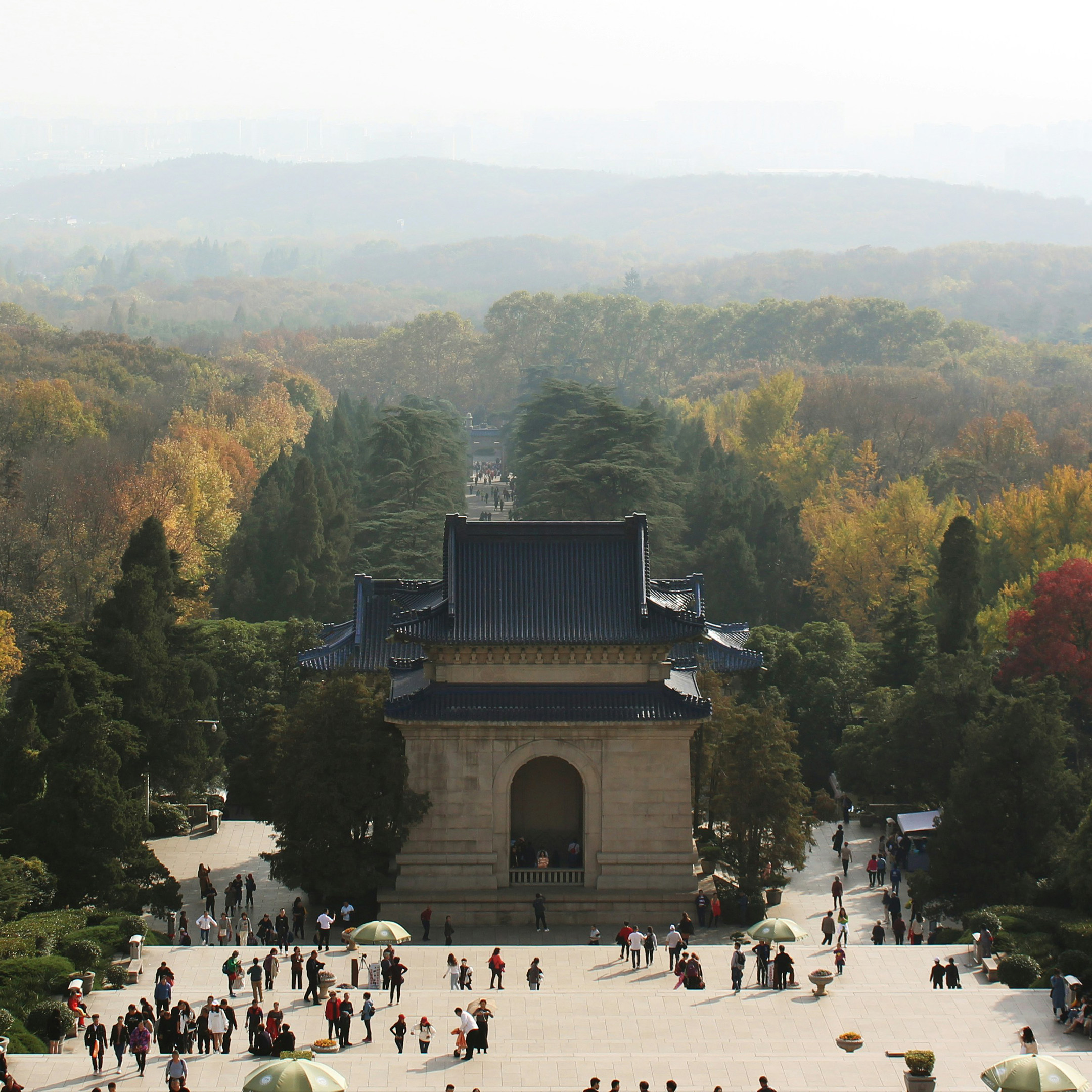
The ascent begins at a memorial archway (paifang) at the base and proceeds upward through a sequence of terraces and platforms connected by broad stone staircases. The 392 steps — representing the 392 million people of China at the time of Sun's death — are flanked by dense pine and cypress plantings. The staircase is designed so that looking up from the bottom, only the steps are visible, conveying infinite ascent; looking down from the top, only the platforms are visible, appearing flat. This optical illusion is one of the mausoleum's most celebrated design features.
Memorial Hall and Burial Chamber
At the summit, the memorial hall (Jitang) is a grand structure with blue-tiled roofs — blue and white being the colors of the Republic of China — and a large seated marble statue of Sun Yat-sen at its center. Behind the memorial hall, the circular burial chamber contains a reclining marble figure of Sun above the actual tomb below. The atmosphere at the summit is solemn and reverential. The views from the surrounding terrace take in the forested slopes of Purple Mountain and, on clear days, the distant Nanjing skyline.
Historical Significance
Sun Yat-sen requested burial in Nanjing, which served as his capital during the brief early days of the Republic. The mausoleum, completed in 1929, was designed by the Chinese architect Lu Yanzhi and blends Chinese traditional architectural forms with modern materials and construction. The site's symbolic importance — as both a personal memorial and a statement of national identity — ensures that it remains deeply meaningful to Chinese visitors.


Getting There
Address: Sun Yat-sen Mausoleum, Purple Mountain, Xuanwu District, Nanjing, Jiangsu, China
The mausoleum is in the central section of the Purple Mountain scenic area. Buses from **Xiamafang Station** on Line 2 serve the scenic area entrance, from which a shuttle or a 10-minute walk reaches the mausoleum base. A taxi from central Nanjing takes roughly 20 minutes. The mausoleum is typically combined with the Ming Xiaoling Mausoleum and Linggu Temple.
Dummy caption
Sun Yat-sen Mausoleum